Monday, October 21, 2013

Pachacamac

Last weekend, we visited the archeological site of Pachacamac located just outside of Lima and I learned a lot about the cultures who lived there because we had a very informative and easy to understand tour guide! Pachacamac is located right on the coast and was inhabited by various different ancient cultures including the Wari, the Lima and later the Inca empire. The majority of the palaces, temples and other buildings were built on a large desert hill which overlooks the ocean and the river below. The people who originally lived there worshiped a the creator god called Pacha Kamaq who was later adapted into Incan culture. When the Incans lived there, they built a special building where girls were sent from age 8 to 14 to learn how to weave, knit and perform other feminine skills that were were important to the empire. It is a very impressive looking structure and fascinating for me to see as a Smithie- that all female education centers existing at this time and that the women lived together in a community. It would be interesting to learn more about this! The museum there had some incredible examples of the textiles that have been discovered there that have been preserved because the climate is so dry. There was a beautiful woven belt, clothing and even examples of the Incan Quipu- the Incans did not have a written language but instead kept there records using a code that used knots on strings to communicate. It was really amazing to see real examples of these because I have read about them.

Wednesday, October 16, 2013

La casa!

I finally got around to taking pictures of the house where I'm living in Huaycán and our street. I love the bright turquoise color of the house and the spiral staircase! On the first floor lives a family that owns a little convenience store which is definitely... convenient for us! On the third floor of the house we have an office, kitchen, dinning room, computer room and living room. The room I share with my two roommates is on the third floor. The street we live on is dirt and is usually filled with harmless stray street dogs and children playing tops. Around the corner is our classroom.

Tuesday, October 8, 2013

recovering and reflecting

Being sick away from home is never fun, especially when you are in a foreign country and far away from your family. Last week I got a bad stomach flu and/or food poisoning and lets just say I couldn't eat anything for a day. I recovered pretty quickly, but I got my week started on the wrong foot and it has taken a while for me to completely gain my energy back. Anyways, I'm better now, but I definitely was feeling homesick and drained last week. After sustaining so much momentum and enthusiasm for being here (and adapting to this new and challenging world pretty quickly if I do say so myself) I suddenly felt a little bit lost and began missing the comforts of home (mostly the people, the food and my bed!) From past experiences, I have realized that homesickness always hits you when you find yourself bored and unable to keep busy and distracted experiencing new things and spending time with your friends. Anyways, I am now back to teaching classes, spending time with our Peruvian friends and eating delicious Peruvian fruit and cake and I am once again feeling very grateful to be here and have this experience. However, sometimes low points can be really helpful for reflecting and perspective. Over the past almost two months that I have been here, I have been in constant dialogue with myself and with others about this experience and what I am learning. Of course, I usually develop more questions that answers, but that's the beauty of curiosity and learning. I once read a Buddhist quotation that explained that confusion can be a positive thing, because it means that your previous assumptions about the world are being questioned and expanded. I can definitely say that I am still even questioning the fact that I am teaching English here and whether is having any kind of positive "impact" on the community here. However, I am realizing more and more that "understanding" what people are thinking and experiencing here is impossible. Furthermore, like any non-profit organization, its hard to know if we are helping or just assuming that we are helping. We can never, ever escape from the fact that we are privileged westerners and our perspective on life has been molded in a very different way and everything we see and experience is sifted through this lens. However, I believe there is incredible value in the fact that we are living in this community and forming relationships with all kinds of people around us. I was talking to one of the other volunteers about this yesterday and the way I explained it is that I think that when you form relationships with people from other cultures and backgrounds, in many ways they act almost as a mirror, helping you to understand your own culture. While we can never understand what it is like to really live in Huaycán, we can learn to understand ourselves and our culture better. When I see Peruvians here find joy in simple things, never waste food, find incredible ways to be resourceful, appreciate family, play and feel pride for their country among many other things, it causes me to realize the things that I appreciate or that I believe are lacking from American culture and my own life. For example, the amount of risk and danger that people here face daily from an American perspective is kind of terrifying. People trust crazy bus drivers, cross the dangerous streets, eat all kind of crazy food, children play on extremely unsafe playground equipment and ride the bus alone. All of this definitely freaked me out when I first got here (and still does sometimes) but I quickly realized that life filled with risk is also more exciting, feels more real and really makes you feel grateful for the incredible perseverance of the human spirit and body to continue in the face of challenge and danger. However, for Peruvians, all of this is "normal" (they actually say this all the time!) There isn't anything particularly remarkable about surviving their daily bus ride swerving in and out of traffic. However, for me, when I arrive safely I feel extra grateful to be alive and I'm once again reminded of how our ideas in the US about safety and life are culturally constructed to be hyper- sensitive. So basically the point of this long winded blog post is to say that I hope that if nothing else, we (the volunteers here) can also provide a mirror for the students and Peruvians we meet here. We can't change a system that is clearly classist, racist and unjust, and therefore provides less economic opportunities to the people living in Huaycan. However, we are forming meaningful and positive relationships with the people living here, that hopefully help them to learn about themselves and their own country and ways that they can appreciate or change their own lives. We are not in a place to judge what is "good" or "bad" about life here and Peruvian culture in general (the practice of non-judgement observation is definitely a challenge!) but we can maybe learn from it and bring this expanded understanding of the world along with us when we return to our own countries or travel to new places. More thoughts on this to come...

Speaking "Peruvian"

Every country has its own slang and as soon as I arrived in Peru, I realized that all of the cool slang that I had learned in Mexico was not going to help me fit in here! Its amazing to see how despite the fact that so many countries speak Spanish, the language varies so much from country to country. Here is a list of some of the Peruvian slang I have learned so far: "Jerga"- literally means slang. "Chao!"- Everyone says chao to say goodbye instead of adios here. "La Chancha"- When everyone goes out to drink beer or share food, the bill that everyone splits is called the "chancha." As I have mentioned before, sharing is a very big part of Peruvian culture! "Una Chela"- the large bottles of beer that everyone shares. "Chato"- affectionate way to describe someone who is short. "Cobrador(a)"- The person who collects the bus fares, tells people to when to get on and off, and the general bouncer of the bus. (Usually is very skilled at jumping on an off the bus very quickly while also giving change and yelling in a very loud voice). "Combi"- Bus (in Huaycan, most of the buses are actually more like vans). When riding a combi, you usually have to squish/ fold/ stretch yourself into many different positions in order to fit and you are usually extremely up close and personal with lots of strangers. The people watching is fascinating! "Baja!"- What you yell loudly when you want the bus to stop and you want to get off (there are not many "official" bus stops. "Que Chevere!"- How cool! (pronounced Cheb-re) "Que roche!"- How awkward! "Piqueos"- snacks such as chips, crackers and candies that are sold on every street corner. "Cuidate!"- Take care! Everyone says this when saying goodbye. "Enamorado(a)"- boyfriend or girlfriend (literally means "in love with") "Palta"- avocado (in Mexico it was aguacate) "Ya fue"- used in many different circumstances basically to mean, "what happened, happened" or "too late" or "that's life" There are a ton more words that I am forgetting and that I am yet to learn! I will add on as I learn!

Sunday, September 29, 2013

Peruvian Pie!

On Friday night, one of my Peruvian friends Luis invited us volunteers to his house in Huaycán to use his oven (we don't have one!) and I decided to make an apple pie in Peru! Inspired by the Smith tradition of Mountain Day (when classes are canceled and Smithies go apple picking) which just happened in the US and my love to making pie, I decided to attempt to acquire all of the necessary ingredients in Huaycán. I asked my mother to give me the family recipe and I set out for the "mercado" (market) with a friend unsure if my mission would be successful. Turns out that our favorite fruit vendor sells green apples perfect for pie! It proved much more difficult to find a pie pan (I got some confused looks) but eventually a woman selling all kind of pots and pans had two tart pans which worked just fine! We bought flour by the kilo and of course cinnamon! On Friday, Luis so kindly welcomed us into his home (it was the first time I had been inside someone's home in Huaycan) and we set to work making the pie! We listened to Peruvian music, chatted and when it came to making the dough, I just had to estimate using a mug and spoons (because they don't use cup and tablespoon measurements here). We definitely had beginners luck, because I managed to mix a dough of the right consistency despite all the estimating! Luis very skilled with the rolling pit and we all helped to put the whole pie together! After lighting the oven with a match, we slipped the first pie into the oven and started in on the second. Unfortunately, I had run out of good luck by that point and the dough came out super crumbly. However, we managed to scrape it together and I fashioned a improvised lattice top. While the pies where baking, Luis brought out his guitar and we had a really fun sing along! He can play pretty much any song on the guitar as long as he looks up the chords, so we had fun singing both spanish songs and the beatles and other songs in English. When the pie was done, Luis put a happy birthday candle on top to celebrate one of the volunteers Adriana's birthday and we all sang to her. We even tried to make some whipped cream- which turned out nothing like whipped cream but was good on top. Everyone really enjoyed the pie and I do think it came out really well, if I do say so myself! I couldn't have done it without all the help from all my friends here! It was a wonderful night and a true reminder of the power of music and food to bring people together and celebrate different cultures!

Sunday, September 22, 2013

The challenges (and joys) of teaching English

Did you know that the following sentence is written in the "unreal conditional" tense of English: "If I had a million dollars, I would travel around the world." ? Well, I didn't until yesterday when I was preparing to teach my adult advanced English class! It's amazing how my understanding of the English language is purely based on what "sounds right" or "wrong" and how I never think about what tense I am speaking with or writing in. Now that I am teaching English, I have to suddenly understand English through the eyes of my students and it isn't pretty. I have quickly learned how hard English is to understand, speak and teach, especially because I have not been properly trained as an English teacher and I'm mostly relying on the textbook and my peers to help me. I have been corrected by my students, I have realized that I speak English incorrectly and I have apologized on the behalf of the English language many times. Mostly, I have become skilled at thinking on my feet and quickly coming up with examples that hopefully partially explain what I am attempting to teach. At least I am able to have a lot of empathy for my students, because I am still in the process of learning Spanish and I still get very confused with Spanish grammar. But to return to my original example, think about the fact that when describing an imaginary situation that would most likely happen in the future, the grammatical structure of the "unreal conditional" requires you to conjugate the verb "I wish I HAD..." in the PAST tense. WHAT??? I often communicate my frustration with the English language to my adult students so that they know that they are not alone in their confusion. However, I find that most often, they are entirely used to craziness that is the English language because they have been studying it faithfully and filling out worksheets for years. I, on the other hand, am encountering the challenges of teaching English grammar for the first time. Thankfully, my students laugh at my jokes and seem to enjoy my enthusiastic, but somewhat clueless teaching style. I like to incorporate fun activities into the class; for example asking them to finish sentences such as, "If I could have any super power, I would choose to..." or "If I had only one week to live, I would...." Considering that most of my adult students are about my age, I really enjoy getting to know them and the opportunity to have discussions with them about their culture and lives. Despite my feelings of frustration and inadequacy teaching advanced English, my experiences in this class and our "conversation club," which is a more informal chance for us to play games and discuss different topics in English with our students, have helped me realize that I really enjoy teaching adults. Who knows, maybe I will look for opportunities to be an University English teaching assistant or something like that for the future. However, I think that taking a "Teaching English as a foreign language" course should probably be in my future before I attempt to teach any more advanced English classes!

Huaycan Sunset

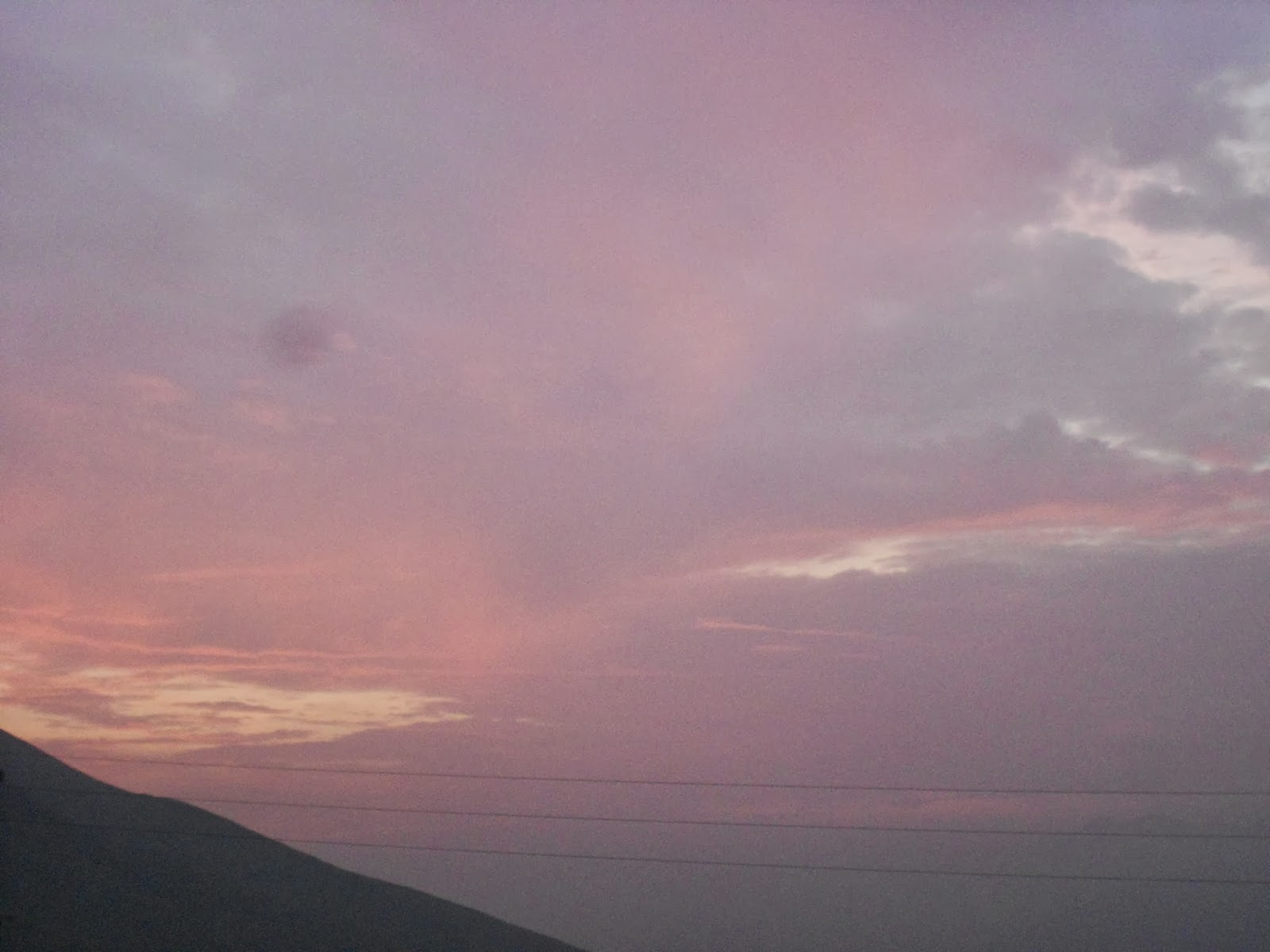
A couple nights ago I looked out the window and the sky was pink! We don't often have sunsets here because it gets foggy at night. I ran up to our roof to take some pictures of the sky and our view of Huaycan...and my hard day's work! We wash our laundry by hand on the roof and hang it to dry...I will never complain about doing laundry with a laundry machine again!